
 Inquire
 Give
Give Calendar
 I Am a . .
 - Our School
- Our Experience
- Admissions
-
Academics
- Academics Overview
- Curriculum
- SciAc
- B.Y.O.D.
- Counseling Services
- Matriculation
- Scholarships for Currently Enrolled Students
- National Honor Society
- Arts
- Athletics
- Families
- Events
- Alumni
- Giving
SciAc | Welcome
SciAc | About
SciAc | Curriculum
SciAc | Calendar
SciAc | Faculty
SciAc | Committees
SciAc | Activities
- Journal Club
- Lunch & Learn
- TeaTime Speakers
- Photography Club
SciAc | In the News
SciAc | Supporters
HC Year-at-a-Glance
SciAc | Contacts
L&L and TeaTime Chronological Playlist (2021-)
Lunch & Learn Speaker Series
#02: Joseph Sauvageau, M.A., Ph.D. `75
4 December 2025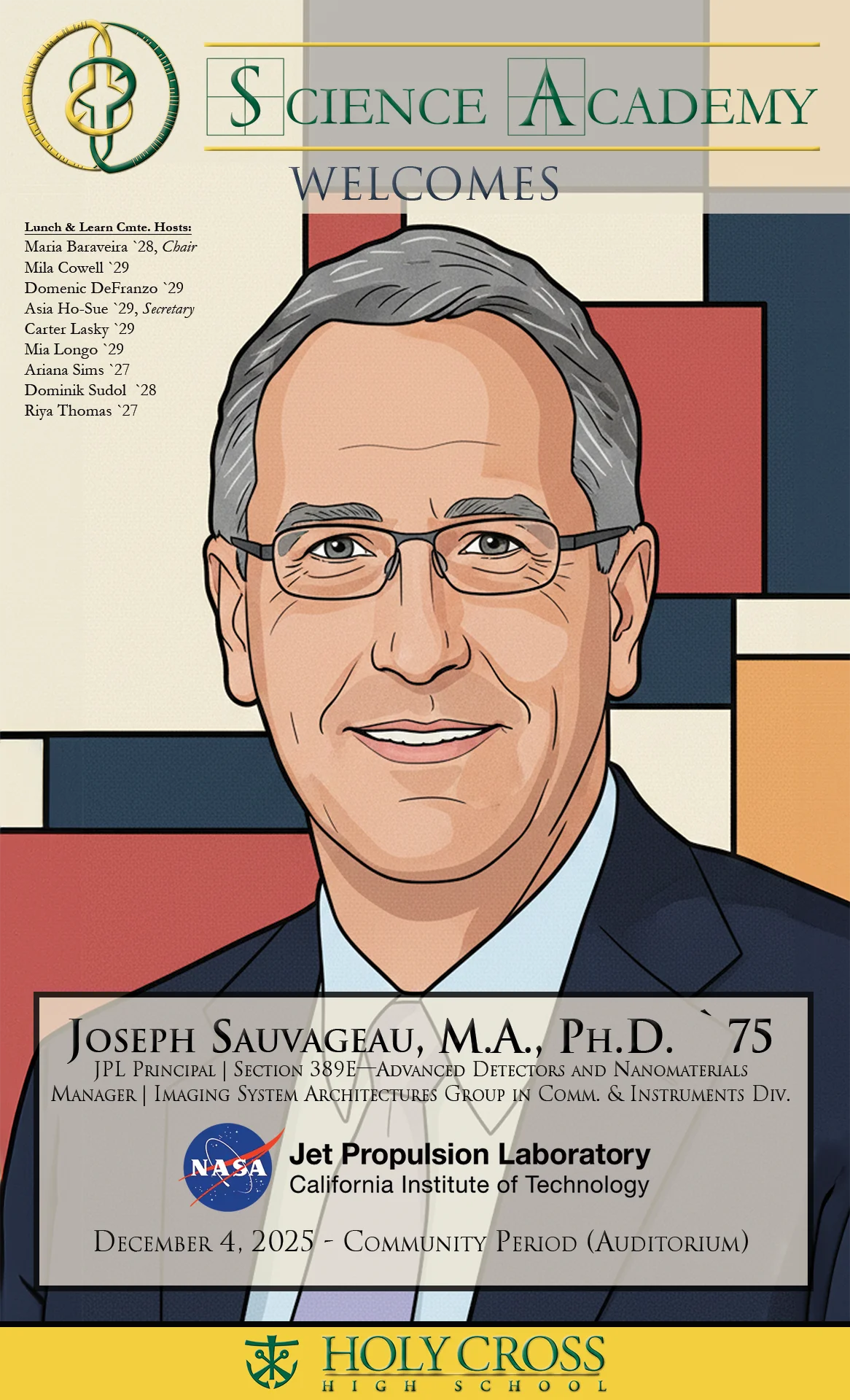
Life and a Career after Holy Cross High School
Joseph Sauvageau, M.A., Ph.D. `75
JPL Principal | Advanced Detectors and Nanomaterials Section
[email protected]
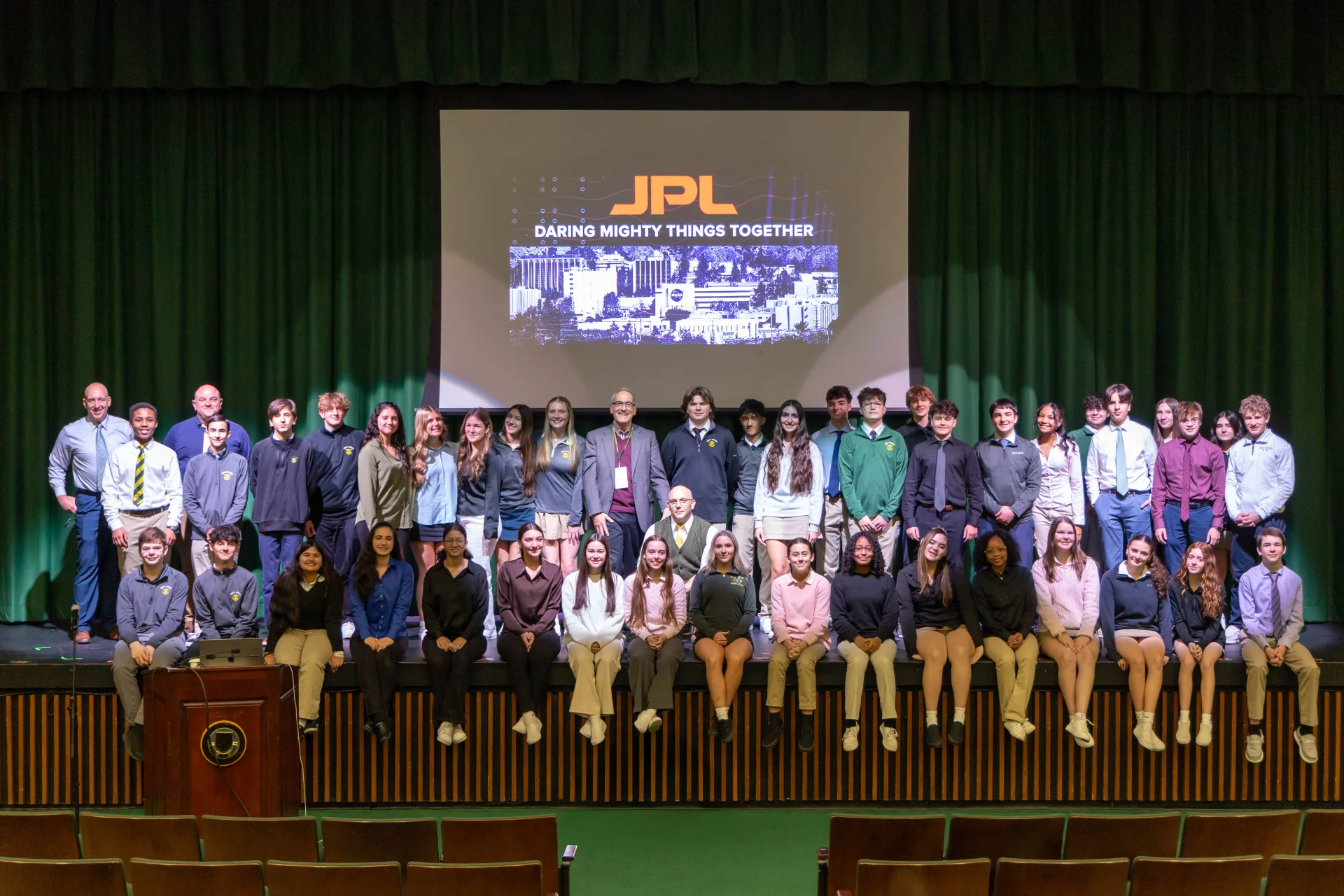
Dr. Joseph Sauvageau,a graduate of Holy Cross in the Class of 1975, is the Manager for the Imaging System Architectures Group in the Communications & Instruments Division at NASA’s Jet Propulsion Laboratory in Pasadena, California. After graduating from Holy Cross, he earned his bachelor’s degrees in Physics and Mathematics from Fairfield University, followed by an M.A. and Ph.D. in Engineering Physics from Stony Brook University. For more than three decades, he has worked at the intersection of physics, engineering, and invention. His contributions underpin the detector technologies that allow our spacecraft to hear the whisper of a distant particle or see the faintest glow from worlds we have not yet reached. His work has shaped missions, instruments, and the very sensors that give humanity vision beyond Earth. The topic of Dr. Sauvageau’s talk was how he got from Waterbury to Pasadena. In 2023, Dr. Sauvageau was awarded the distinguished “Principal” designation for leading the Advanced Detectors and Nanomaterials Section—the group responsible for building the sensor technologies that let NASA missions observe what would otherwise be invisible. Being a Principal means that he is one of the top technical authorities at JPL and that his work has shaped missions from concepts to flight execution. If you’re a genuine nerd, that should have given you goosebumps—and so should the talk...
#01: Charles W. Mandeville, Ph.D.
25 October 2024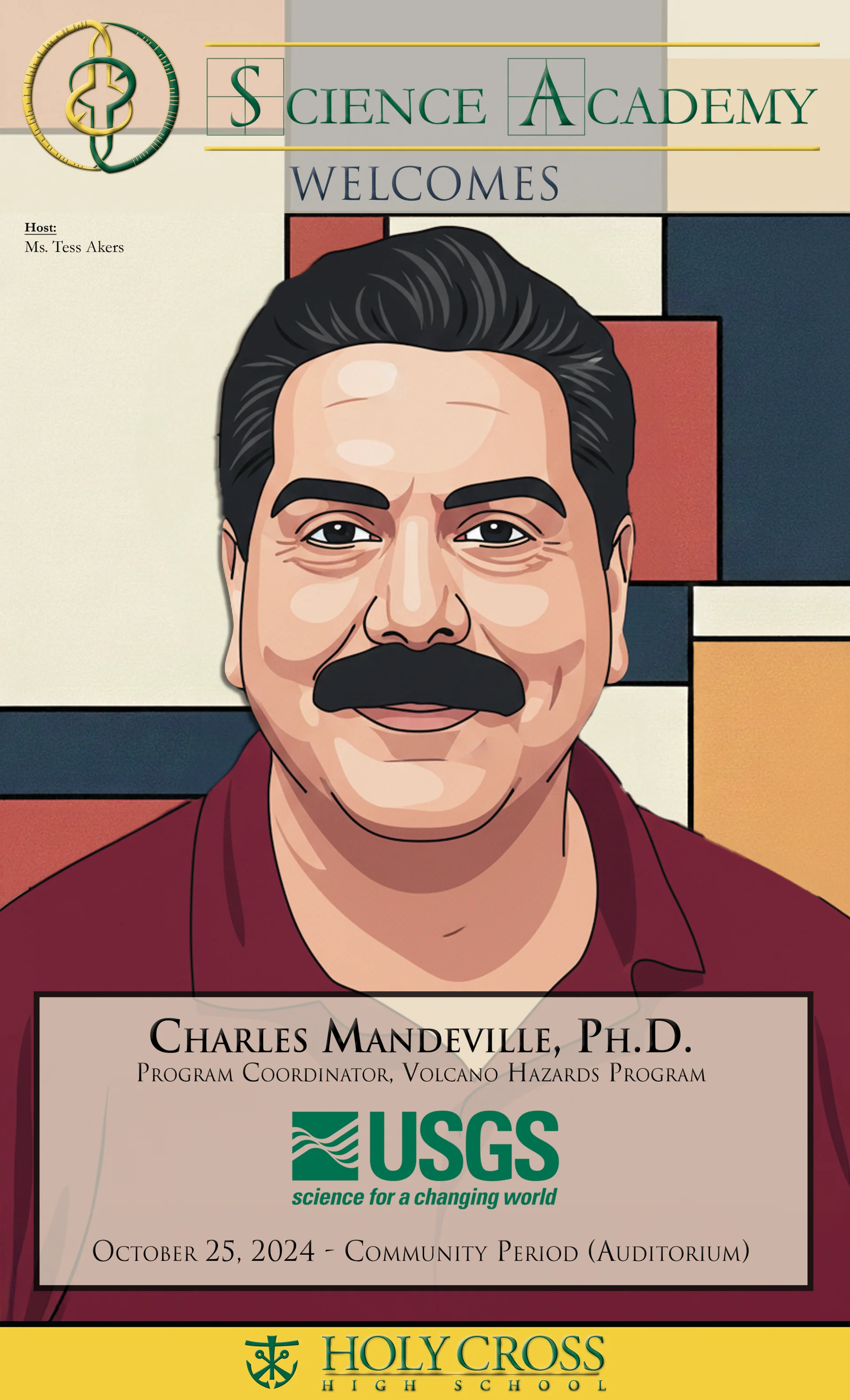
Building a National Volcano Early Warning System (NVEWS) for the Future
Charles W. Mandeville, Ph.D.
Program Coordinator | Volcano Hazards Program
[email protected]
Dr. Charles W. Mandeville is currently a research geologist for the Alaska Volcano Observatory of the U.S. Geological Survey (USGS) where he is working on a volcano-caused tsunamis hazard assessment for active Alaskan volcanoes. Dr. Mandeville served as the Program Coordinator (head) of the USGS Volcano Hazards Program for over ten years and as the deputy program head for 2.5 years. Prior to his service at USGS, he was a senior research scientist at the American Museum of Natural History for more than 13 years. He is a trained physical volcanologist and geochemist, and has conducted volcano research for the National Science Foundation at numerous sites throughout his career, including Krakatau and Galunggung volcanoes in Indonesia, Mount St. Helens in Washington, Crater Lake in Oregon, and Augustine Volcano in Alaska. He earned a bachelor’s degree in geology from the University of Rhode Island (URI), a master’s degree in geology from Virginia Tech, and a Ph.D. in oceanography from the URI Graduate School of Oceanography. In his years as Program Coordinator for the USGS, he was directly involved with efforts to establish a National Volcano Early Warning System for all active volcanoes in the United States and assisted in the management of the Volcano Disaster Assistance Program (a partnership between the USGS and USAID Bureau of Humanitarian Assistance) which assists developing countries during times of volcanic crises.

Contact Information




